


Speak with Ida...
Learn more about the path of Bhaerawa!
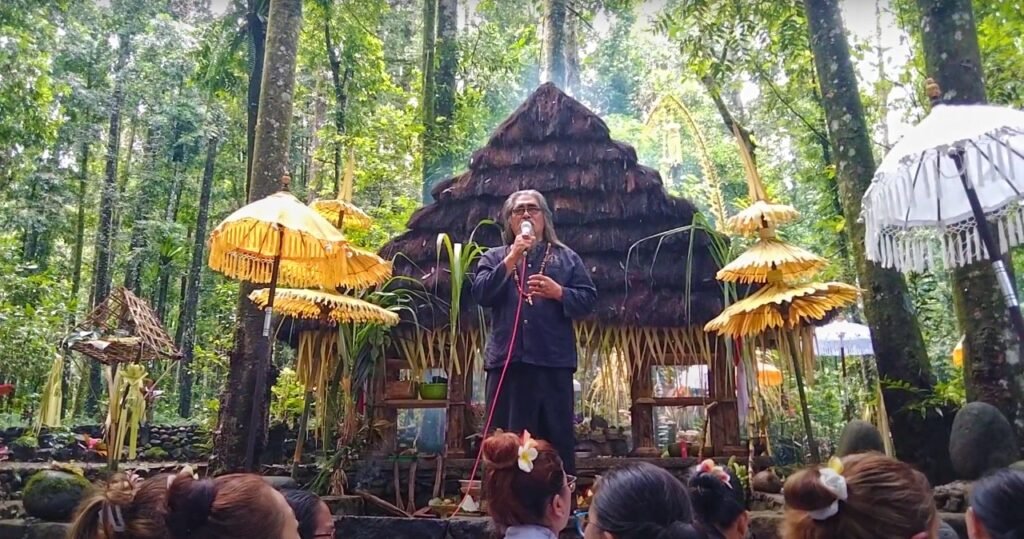
1. When you look back to the earliest whisper that called you toward spirit, what moment or age first lit that flame within you?
Ida: When boredom led to being a mischievous young man, around the age of 20. Before that, I greatly enjoyed exploring the knowledge of kawisesan (mystical wisdom).
2. How did the sacred doors of the Bhaerawa path first open for you, and when did you step through?
Ida : It began with a dream of eating rice mixed with blood.
3. Your journey with Ida Istri seems woven in devotion and purpose. Could you share the story of your path together in spirit?
Ida :A spiritual journey must be balanced between husband and wife. Both must complement and support each other for spiritual growth. It must not be done alone, as it will likely have a negative effect on the balance of energy.
4. What vision breathes within the Yayasan you founded, and what destiny do you wish it to serve?
Ida : Serving and ministering to the community. Because when one serves God’s creation, it means they are already serving God.
5. The name Bhaerawa often stirs fear in those who do not understand. Why do you think this shadow exists around it?
Ida : There has been a deliberate attempt at character assassination, shaping public opinion to declare that the Bhaerawa teaching is heretical and carries a negative connotation.
6. During ceremonies, your hair sometimes flows freely instead of being tied — what is the meaning hidden in this gesture?
Ida: In the Buddhist priesthood regulations in Bali, there are three rules about hair:
A. May be cut to shoulder length, called ANGARAS BAHU or SIPAT AKING.
B. May be shaved completely bald, called AMUNDI.
C. May be worn long and loose, not tied, called ANGORE.
7. Melukat is spoken of as a sacred cleansing — why is it so important to receive it regularly?
Ida : One way to cleanse oneself is through melukat. Melukat can be done by bathing at a natural spring, or at a Griya, Pasraman, or Padukuhan. The hope is that after melukat, the mind, soul, and body will be calmed.
8. When you and Ida Istri guide melukat, you invite families to seek forgiveness from their parents. Why is this act so essential, and how does it shape the journey of the heart?
Ida: This is also one of my ways to erase the bad karma we have created. Mistakes or sins cannot be erased by prayer alone, nor by vows/observances, nor by meditation, nor by fasting. A mistake or sin can only be erased by the awareness to sincerely ask forgiveness from anyone we have wronged and by being ready to change ourselves for the better.
9. Could you share a moment where you witnessed forgiveness transform a soul and alter the path of a life?
Ida: A change will certainly happen if it is done with full awareness, sincerity, and a willingness to transform into a better person.
10. The ceremonies you lead are graced with holy objects, some of which you craft yourself. Can you tell us of their power, and the way they are born into being?
Ida:They (the sacred objects) are created out of awareness, goodness, humanity to help others, and faith.

11. As a pedanda, your days overflow with ritual, teaching, and care for students. How do you hold such a rhythm, and what sustains your devotion?
Ida: My work is supported only by the awareness to serve and minister to the community.
12. In the face of misunderstanding and resistance, what inner fire compels you to keep bringing Bhaerawa wisdom into the light?
Ida: Living in the modern era naturally comes with many rhythms of life. I cannot please everyone because my ability is limited. No matter how well I serve and minister, there will always be some who are dissatisfied with what I do. What matters most is that I always strive to serve and minister in the best way possible.
13. In your eyes, how do the great tides of human emotion move through life — anger, jealousy, sadness, helplessness, joy, resistance, laziness, the fog of blame?
Ida:It is a law of nature that human life is accompanied by feelings such as anger, jealousy, envy, resentment, disputes, blaming others, as well as kindness and wisdom. Therefore, we must always remain aware of these.
14. How do these emotions carve the lines of karma?
Ida: Karma for those still living is the passing down of habits to the next generation. For example: if parents educate their children by shouting or using violence, even to the point of hitting, the child’s character will usually become as harsh as the parents’. But if the child becomes aware that harsh education is not good, and when they have their own family they choose to teach their children with love and peace of heart, this will certainly cut off the negative karmic inheritance from their parents and instead pass down love to the next generation.
15. Is it truly possible for a soul to reshape or cleanse its karma?
Ida: It is very possible, as long as it is awakened with awareness.
16. In this age where foreign winds, digital voices, and outside cultures touch the youth of Bali, what sacred duty do they carry to keep the lineage of their ancestors alive?
Ida : Educating them with the awareness that they are God’s creation and spreading love.
17. What is the most fragile truth of spirituality that is so often misunderstood?
Ida: Accepting “truth” merely from hearing stories without seeking to understand or feel its essence.
18. How do you see time — and why is the steady rhythm of spiritual practice so vital?
Ida: Success can only be achieved with determination, spirit, courage, and perseverance. Without these, it will be very difficult to realize a spiritual dream.
19. You are known for not binding anyone to the weight of their past, but guiding them toward the road ahead. What wisdom shapes this way of seeing?
Ida: The past is a time that has already passed, and it is impossible to go back to change it into something good. Therefore, the best thing is to leave the past behind and become a new person full of goodness.
20. For the one standing at the edge of the Bhaerawa path, trembling with fear, what first steps could they take toward courage?
Ida: The Bhaerawa path teaches overcoming fear through courage. For example, when we fear the dark, begin to learn within that darkness. Sit calmly, and once calm, ask yourself: “What am I afraid of in this darkness?” Feel all the sensations of that moment. Do not force yourself to sit too long at first — begin with just 10 minutes, and continue regularly while gradually increasing the quality and length of time.
21. Why do you sometimes lead meditation in the stillness of night — or even amidst the silence of cemeteries?
Ida: As in the answer above, learn to be brave enough to face stillness with awareness.
22. How do you know when a seeker is truly ready to walk the Bhaerawa way?
Ida: By observing their actions, behavior, and character.
23. For someone drawn to this path yet bound by hesitation, what words would you offer to open their heart?
Ida: Make them aware that the Bhaerawa path does not promise worldly pleasures.
24. You and Ida Istri are often seen embracing children with warmth and tenderness. What place do the youth hold in the spiritual future of Bali?
Ida: To always spread love.
25. For those far from temples yet close to longing, could you share a simple meditation they can begin at home — a doorway to their own stillness?
Ida: Respect the body, love the body — for the body is a temple, a sacred place. Once you can respect and love your own body, seek Bhaerawa within yourself.
26.The skull often appears in the visions and images you share, Ida. Could you speak of the deeper currents it carries—what truths or mysteries does this symbol hold?”
Ida :The skull is a symbol that represents the destruction of illusion, the conquest of the ego,and the eradication of fear.